Gimbal or in body stabilization: which is smoother?
Gimbal or in body stabilization: which is smoother? How each works, where each wins and when to use both.
On this page
This is a source-informed explainer, not a hands on test. The gimbal example is the DJI RS 4 Mini, using DJI's specification page, and the in body stabilization facts come from a Canon explanation of the technology. We did not test either.
How in body stabilization works
In body image stabilization, or IBIS, moves the camera's sensor to cancel small shakes. Canon describes sensor shift correction on five axes, driven by a gyro, an accelerometer and the image sensor, which feed a processor that decides how to move the sensor. It is built-in, always available and works for stills and video. It is very good for small shake, such as hand tremor, and for stills at slow shutter speeds. Canon quotes up to eight stops of correction on the EOS R5 and R6 with non stabilised lenses, which is a manufacturer figure for stills under test conditions, not a promise for video.
How a gimbal works
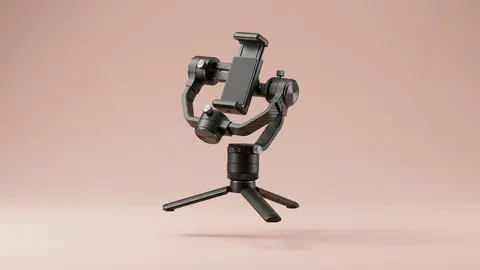
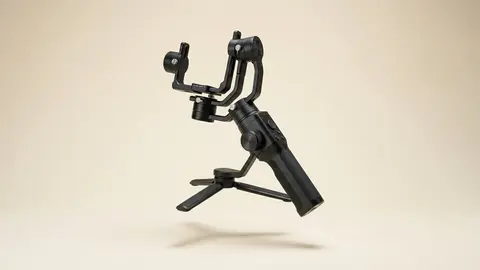
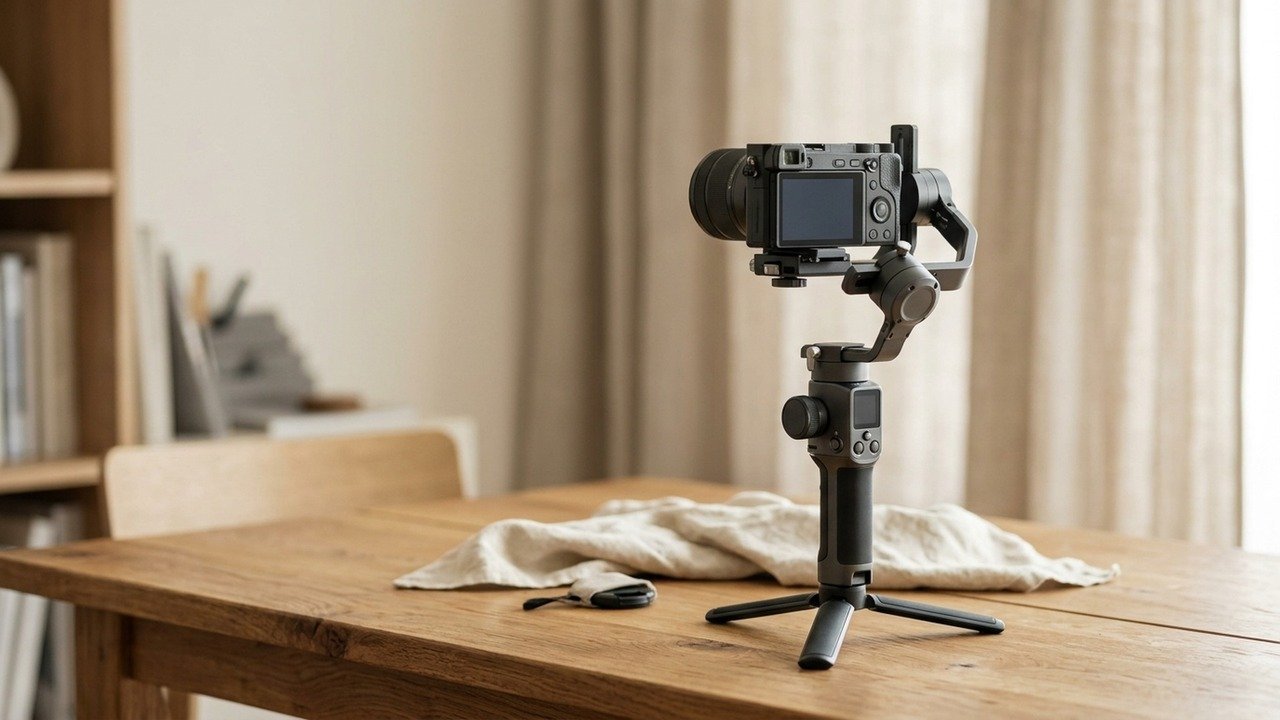
A gimbal is a handheld stabilizer with motors on several axes. It senses movement and moves the camera in the opposite direction. Because the camera hangs on motors, the stabilizer can absorb bigger movements, like walking steps, and make the shot look like it glides. DJI lists the RS 4 Mini as rotating 360 degrees in pan, with a tested payload of 0.4 to 2 kg.
Where each wins
Walking shots. A gimbal wins. Footsteps create a bounce that IBIS cannot always remove completely. Small hand shake. IBIS handles it well. Stills. IBIS only. Handheld run and gun. IBIS is lighter and faster. Cinematic moves. A gimbal gives control over pan, tilt and roll.
Canon also notes that IBIS works best on shorter focal lengths while lens stabilization works better on longer ones, so the lens you use matters as much as the body.
Using both
Many cameras let you use IBIS with a gimbal, and some recommend turning it off. Canon describes a Coordinated Control mode in which IBIS and lens stabilization work together. The right choice depends on the camera and lens, so read your camera and gimbal manuals. Electronic stabilization, which crops the image, is another option you may combine. Canon's explanation does not address video limits, so check your camera's own notes.
Cost, weight and setup
A gimbal costs more and adds weight. DJI lists about 890 g for the RS 4 Mini, on top of your camera and lens. You must balance the camera, which takes time. Compact models such as the RS 4 Mini reduce the load, but you need a battery, a case and some practice. DJI lists a 13 hour maximum run time and about 1 hour 50 minutes to charge at 30 W.
Which to choose
If you shoot walking video, interviews on the move or events, a gimbal is a big step up. If you mostly film static shots or want the lightest kit, a camera with strong IBIS may be enough. If you are undecided, start with IBIS and add a gimbal only if walking shots still look bouncy. See how to choose a camera gimbal and gimbal specs explained.
DJI RS 4 Mini Combo
A compact camera gimbal stabilizer for Canon, Sony, Nikon and Fujifilm cameras.
Real situations
Consider a few examples. A traveller films a market walk with a compact camera: a gimbal gives the smooth glide, while IBIS alone leaves some bounce. A person records a seated interview on a tripod: IBIS or no stabilization at all is fine, and a gimbal adds nothing. A photographer shoots a handheld still in dim light: IBIS lets a slower shutter speed work, and a gimbal is irrelevant. A wedding videographer moves through a room for several hours: a gimbal helps but fatigue is the limit, so a lighter setup may win. In each case, match the tool to the movement.
A simple test
Before buying, film the same ten metre walk with your camera in your hands and in body stabilization on. Watch it on a large screen. If the bounce bothers you, a gimbal will help. If it looks fine, you may not need one. The test costs nothing and answers the question for your camera and lens. Repeat it with the lens you use most, because stabilization behaves differently from lens to lens, and note whether the footage is for social media or a large screen.
What about electronic stabilization?
Many cameras offer an electronic mode that crops the frame and shifts it to hide shake. It costs resolution and field of view, and it can look odd with fast turns. It is a free addition when it works, but it is not a substitute for either IBIS or a gimbal. Check how your camera describes the mode, and whether it can run together with IBIS, since some combinations are limited.
Lens stabilization
Canon's explanation also describes stabilization built-into lenses, which works alongside IBIS in a Coordinated Control mode. Lens stabilization tends to help more on long focal lengths, and IBIS on shorter ones. If you use a stabilized lens, your result depends on both. When you compare bodies, check whether your lens stabilization is supported, and how the camera combines them.
Be careful with
Buying a gimbal without checking your camera and lens weight against its payload.
The practical answer
Use IBIS for everyday shake and stills. Add a gimbal when you walk, move or need smooth, deliberate camera moves.
Questions people ask
Is a gimbal smoother than IBIS?
For walking and moving shots, usually yes.
Can I use both?
Yes, but some cameras need settings changes. Check your camera and gimbal.
Do I need a gimbal for photos?
No, it is for video.
Is a gimbal heavy?
Compact ones like the RS 4 Mini are lighter, but they still add weight.
Sources and scope
Reference material is linked for the scope described below. This is not a claim that every statement or current retailer offer has been independently verified.
- DJI RS 4 Mini specifications (DJI): manufacturer specifications
- What you need to know about in-body IS (Canon): technology explanation
No hands-on testing or systematic reliability study was performed. Confirm current instructions, seller, model and box contents before ordering.