How to choose a mini fridge
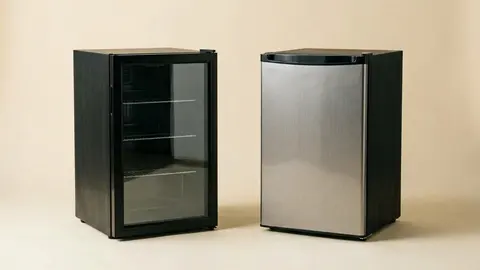
Choose between a beverage cooler and a compact food fridge. Check freezer layout, ventilation and shelf space before trusting a can-capacity headline.
On this page
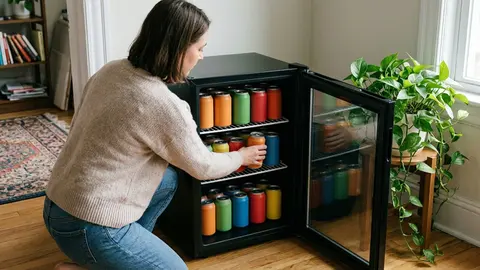
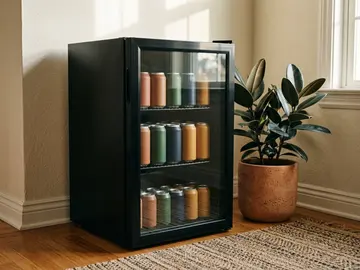
A compact appliance filled with cans may look right for your office and still be the wrong choice for storing lunch. Decide whether you need drinks, perishable food or frozen food before comparing capacity.
Food storage comes before appearance
A beverage cooler is not automatically suitable for perishables. Check whether the maker explicitly supports the intended food storage and the conditions needed to maintain it.
The FDA recommends keeping a refrigerator at 40°F or below and a freezer at 0°F. It also recommends an appliance thermometer because a control setting is not necessarily a measurement of the actual temperature.
Those are food-safety targets, not a claim that every compact fridge or small freezer compartment can achieve them. Choose an appliance documented for your intended use, then verify temperatures in use.
Three jobs, three different checks
| What you need to store | Starting question | Evidence to obtain |
|---|---|---|
| Drinks only | Will the bottles and cans fit? | Shelf layout, intended use and operating range |
| Lunch and other perishables | Can it maintain safe refrigerator conditions? | Food-storage approval, instructions and an appliance thermometer |
| Frozen food | Is there a suitable freezer? | Compartment rating and documented temperature capability |
Do not treat a drink-temperature range as food-storage approval. Likewise, an ice-making compartment or small cold box should not be assumed to perform like a separate freezer.
Check the real shelf layout
Make a list of the containers you actually use: a lunch box, milk carton, bottles or meal portions. Advertised can capacity describes a particular arrangement and may tell you little about your own items.
Check internal dimensions, shelf adjustment and the space occupied by controls or a freezer compartment. If possible, compare measurements rather than relying on a wide-angle product image.
Door storage and shelves may have different restrictions. Use the instructions for what belongs where; do not assume all space is equally suitable for every food.
Installation needs airflow and door access
An appliance must fit while operating, not just while parked. Read the required ventilation clearances and keep the intended installation type clear. A freestanding model should not be enclosed in a cabinet unless the manufacturer permits it.
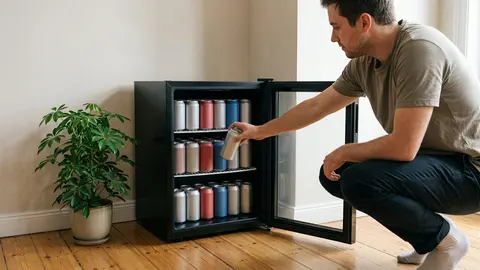
Check whether the door can open far enough to remove shelves and containers. Include plugs, handles and cable routing in the space plan. An advertised body width does not settle every installation question.
For a garage or other unconditioned space, check the maker's approved ambient-temperature range. Do not assume a domestic compact fridge will behave correctly in every climate.
Read the defrost and cleaning instructions
Identify whether a compartment needs manual defrosting and how that process is performed safely. Do not chip ice away with an improvised sharp tool.
Cleaning access matters if the fridge is used daily. Check how shelves are removed, how spills are handled and which cleaning products the maker allows. Keep maintenance directions for the exact model.
Verify the first week of use
Day 1: place the appliance according to its manual and let it stabilize for the stated period. Day 2: set the control conservatively and add an appliance thermometer. Days 3-7: check temperatures at consistent times, watch door sealing and adjust only as the instructions allow. If perishable food cannot be kept safely at or below 40°F, do not rely on the unit for that job.
Follow setup and stabilization instructions before filling the appliance. Use an appliance thermometer and check temperatures regularly, as the FDA advises. A knob position or the fact that a drink feels cold is not enough for perishable-food storage.
If the appliance cannot maintain the necessary conditions, do not keep perishables in it while trying to work around the problem. Consult the manufacturer and current food-safety guidance.
Numbers to look for
Igloo lists its 3.2 cu ft model at 32.5 x 17.13 x 18.625 inches with a one year warranty, though the retailer spec table is unclear on capacity and door reversibility. ENERGY STAR lists a certified compact refrigerator of 1.0 cubic feet at 241 kilowatt hours per year, which shows what an annual energy figure looks like. Neither is a recommendation.
Food safety
The FDA advises keeping a refrigerator at 40°F or below and a freezer at 0°F, checked with an appliance thermometer. Check yours for the first week.
Placement
Leave clearance for airflow, keep the unit level and out of the sun, and allow it to stand before plugging in if the manual says so.
A simple buying routine
Measure the space and door swing. Decide whether you need a freezer compartment or only a drinks chiller. Check for an annual energy figure and a stated capacity. Read the defrost instructions, because manual defrosting means a messy task every few weeks. Put a thermometer inside for the first week and compare it with 40°F. If the box cannot hold that temperature in your room, return it.
Also think about noise. A compressor in a small bedroom is more audible than in a kitchen, so check the return window and test it overnight.
The buying checklist
- The appliance is approved for your intended contents.
- The compartment capabilities match refrigeration or freezing needs.
- Your actual containers fit the shelves.
- Ventilation, door access, electrical requirements and room conditions are suitable.
- Defrosting, cleaning, warranty and returns are understood.
This guide deliberately avoids unverified model recommendations. For another kitchen decision, see our blender guide or air fryer guide.
Questions people ask
Can I keep perishables in a beverage cooler?
Do not assume so. Confirm the maker's intended use and ability to maintain safe food-storage conditions.
How can I check the temperature?
Use an appliance thermometer. The FDA recommends refrigerator temperatures at or below 40 degrees F and freezer temperatures at 0 degrees F.
Can a freestanding fridge go inside a cabinet?
Only if the maker permits that installation and all required clearances and operating conditions can be met.
Sources and scope
Reference material is linked for the scope described below. This is not a claim that every statement or current retailer offer has been independently verified.
- Igloo 3.2 cu ft refrigerator IRF32PL6A (Home Depot listing): retailer listing
- ENERGY STAR certified residential refrigerators (product finder): energy data for one listed unit
- Refrigerator and freezer temperatures (U.S. FDA): food-safety guidance
No hands-on testing or systematic reliability study was performed. Confirm current instructions, seller, model and box contents before ordering.